
20th November 2026
Abbey of St Edmund, some interesting facts
To celebrate St Edmund’s Day, November 20th, historian and author Martyn Taylor provides us with some facts and figures about the Abbey of St Edmund.
In 1020 King Cnut built a stone rotunda church then ousted secular monks, replacing them with Benedictine monks from Ely and Benet at Hulme in Norfolk.
The Abbey would end up controlling the town for over 500 years. The subsequent abbey church was the largest Romanesque church in Northern Europe and if Henry VIII had not had the dissolved the abbey church would have become an enormous cathedral or minster and Bury St Edmunds by now would be a city probably larger than York, Durham or Lincoln.
Such was the draw of the shrine of St Edmund; royalty visited the town. For instance, Edward the Confessor visited St Edmund’s shrine, the last mile barefoot whilst Henry VI visited the Abbey in 1433 at Christmas staying until Easter 1434 with his large entourage, costing the Abbey a fortune feeding them!
At least 14 sovereigns have visited Bury St Edmunds and its abbey, the last was Queen Elizabeth II when she gave out Maundy money in 2009.
Dame Elizabeth Frink’s fine statue of St Edmund at the West Front commemorates the loss of West Suffolk as a county when it joined East Suffolk in 1974 to become Suffolk.
The last abbot John Reeve, aka De Melford, was given a huge pension on his ejection but died without collecting it, some say of a broken heart. He is buried in St Mary’s Church as is Mary Tudor, Queen of France younger sister of Henry VIII. She was originally buried in the abbey church in a magnificent alabaster tomb but moved to St Mary’s at the dissolution in 1539. Neither Henry nor Charles Brandon, Duke of Suffolk her husband, attended her funeral in 1533.
The Abbeygate, the secular gateway to the Abbey, was destroyed by the townspeople in 1327 following the grim demise of Edward II but rebuilt in the English Decorated style by 1347 with embellishments, niches for statues of saints etc. The latter cast out at the Reformation. The gate was deliberately built off centre from the Cook Row (today’s Abbeygate Street) so cartloads of straw could not rolled down to set fire to the gate as happened in 1327. According to famous academic and ghost writer M R James, the three niches above the portcullis, (which is a Victorian replacement), may have had statues of St Edmund flanked by two Danish archers. So called Stars of David on the front of the Abbeygate have faith as when this gateway was built between 1327 and 1347, they had been expelled from England 137 years earlier by Edward I. Yes religious, but they possibly relate to a Double Trinity.
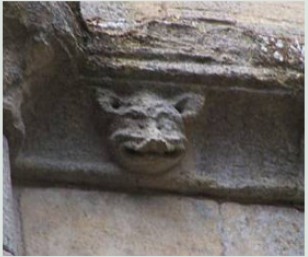
Did you know there are small animal stone sculptures on the rear of the Abbeygate including that of a cat and a pig?
The other magnificent gateway to the Abbey, the religious entrance known to us as the Norman Tower, was built by Anselm, an Italian abbot (1120-48) and can be referred to as a Campanile. a stand-alone belfry of the Abbey much favoured in Italian architecture viz that at Pisa. In 1785, Thomas Osborn of the Downham Market Bell Foundry hung ten bells in the Norman Tower, the only complete set ever in any belfry at one time.
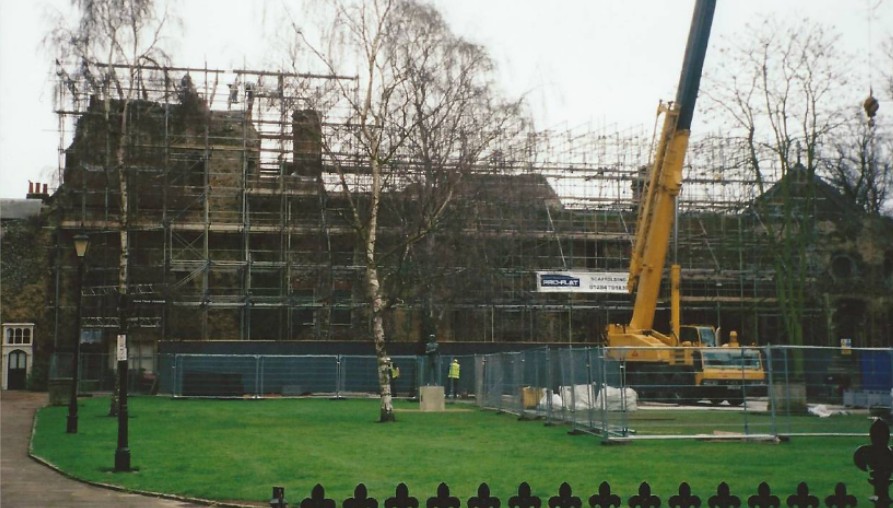
During the refurbishment of the Abbey’s West Front in 2005/6, a worn track in the flintwork up high was discovered caused by the monk’s hobnailed sandals. There were 3 large archways into the West Front, the central arch being reserved for royalty, upper members of society along with clergy. The facing left arch had pilgrims in their thousands over the centuries enter and come out of the right arch or vice/versa. A superlative bronze door made by Master Hugo was at the West Front main entrance.
Grapes to make wine for the religious services were indeed miraculously grown on Vinefields (as named today). These vine fields faced North-West, usually grapevines faced South to take advantage of the sun. The 60-80 Benedictine monks at the Abbey could drink up to B pints of beer a day (that’s a gallon). Mind you it was only 5% ABV so hardly likely to get them sloshed. The brewers at the abbey not really realising that the brewing process killed all the ‘nasties’ in the water but those monks taking a ‘sicky’ could have a couple of extra pints!
There was a dovecote in the Abbey, their flesh and eggs were very important as was the dove poo, To fertilise the monks’ vegetable gardens.
Nearby, the River Linnet was diverted to form a mill pond near to the Abbot’s bridge is today; the townspeople could not grind their grain in any other mill. It was all about gathering money from the charges made for this service.
At Bury, the two daily meals were taken in silence in the refectory. The monks rose in the morning to start the daily services, aka The Divine Office. They were Vigils(Night Office), Lauds (Morning Office), Tierce (Third Office), Sext (Sixth Office), None (Ninth Office), Vespers (Evening Prayer) and Compline (Night Prayer). Mass was the central liturgical service of the day. The monks supposedly did not have underwear only wearing it on visits outside Of the Abbey. Hopefully returning their garments to be washed by the laundress!
An officer of the Abbey was known as an Obedientiary, the monks followed the rules of St Benedict hence Benedictine. They all held specific roles i.e. the Cellarer provisioned the Abbey whilst the Sacrist looked after the infrastructure of the Abbey but strangely could also collect the dung from the Streets! An interesting role was that of the Refectorarius or Comptroller, who looked after the refectory (dining hall) supplying crockery, table linen, furniture, mats: also responsible for putting rushes and straw on the floor and importantly doling out the cheese. There were Latin names for many of the officers, a version of an Almoner gave alms to the poor. The Pittancer collected small parcels of food left over from the monk’s meals, to give to the poor, small being the operative word hence the phrase “not working for a pittance”. After the dissolution poor of the town had to rely on the generosity of the Guildhall Feoffees to help look after them.
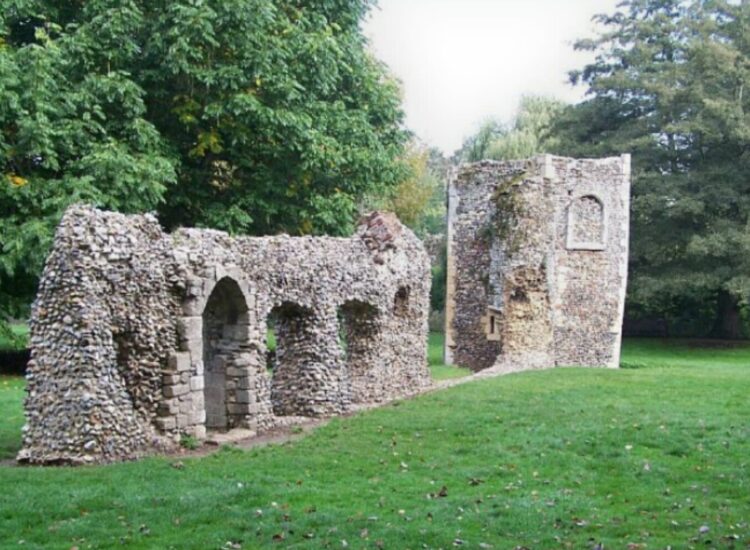
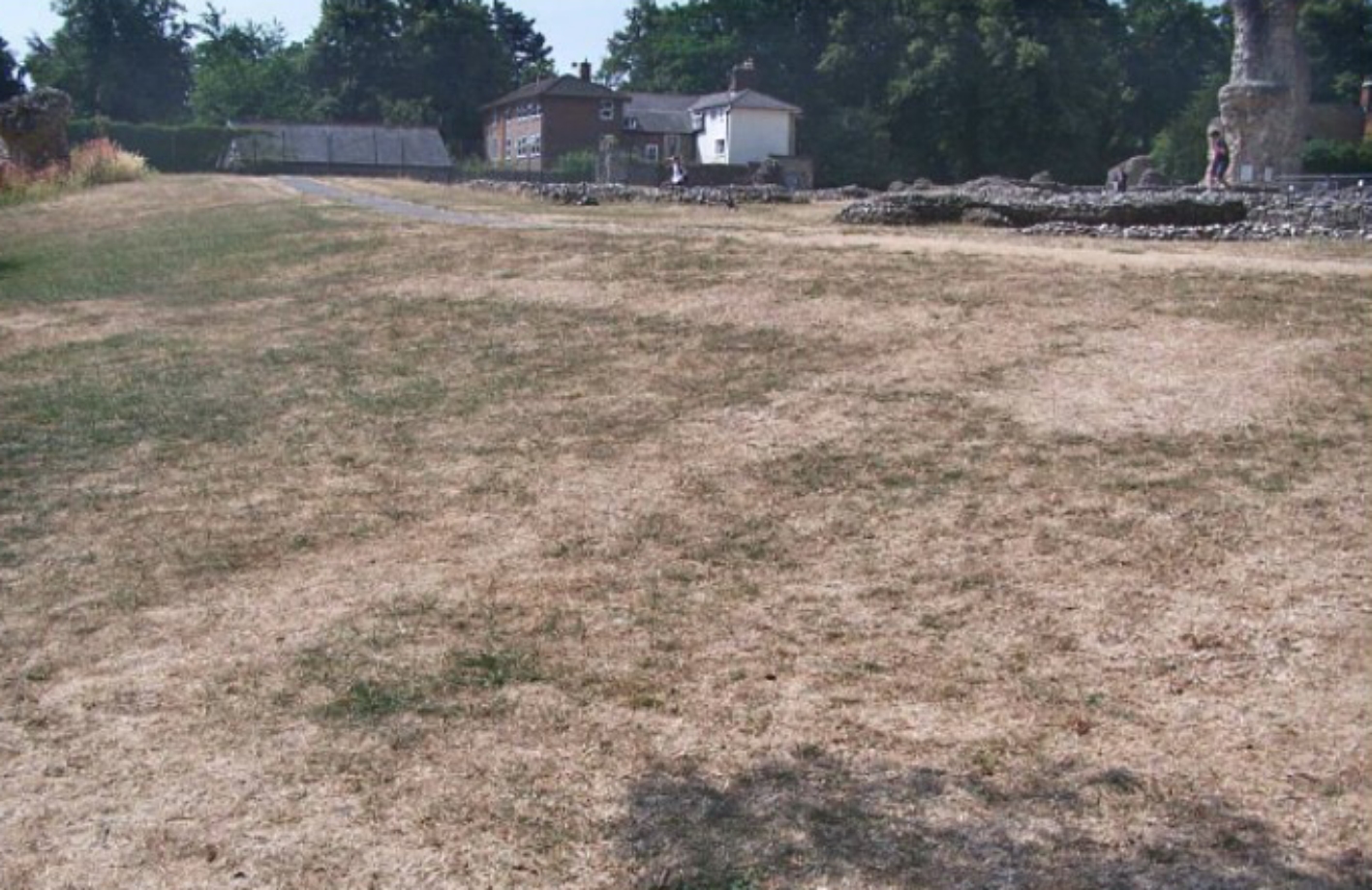
No known images of the abbey church survive but the footprints of the ruins tell us the size of the church. Interestingly, the intense heat of the 2028 summer showed via parch marks hidden walls of parts of the abbey.
There were thirty three abbots during the 500-plus years of its existence. Six buried in the Chapter House were disinterred on New Years Day 1903, five of which were re-buried in their own coffins, see skeletons in the Spanton Jarman photo collection.
Once thought incorrect that 25 Barons met on November 20th, 1214, not only to celebrate Edmund’s martyrdom day but secretly to compel King John to agree to Magna Carta; however it has been now proved they did but in October of 1214.
Not only was Edmund venerated here but also his religious relics such as his nail parings, shirt and sword. Others were relating to St Lawrence, the coals he was roasted on, pieces of the Holy Cross plus Thomas A Becket’s penknife.
So, is Edmund really buried under the monk’s cemetery, where the tennis courts were? Later theories abounded that he could be in an iron bound chest?
The Abbey Gardens were created on the Great Court of the Abbey by Nathaniel Hodson in 1831, the abbey site owned by Frederick Hervey, 1st Marquess of Bristol, created thus in 1826. He is hereditary High Steward Of the Liberty of St Edmund. In 1912 the Bury Corporation obtained the Lease from the Marquess to celebrate George V’s coronation, then purchasing the freehold in 1953 to celebrate Queen Elizabeth’s coronation.
It is English Heritage’s most visited free entrance site where I’m sure you can discover more interesting facts about the Abbey.
Similar articles
18th November 2026
Newsletter for the Abbey of St Edmund project
There is a new digital Newsletter keeping you up to date with…
15th October 2026
Abbey of St Edmund Reborn – Project Board Recruitment
An opportunity to contribute to a major heritage, environmental and community project…
17th July 2026
Abbey Reborn awarded major grant
On July 15, St Edmundsbury Cathedral, West Suffolk Council and English Heritage,…
View all news